






















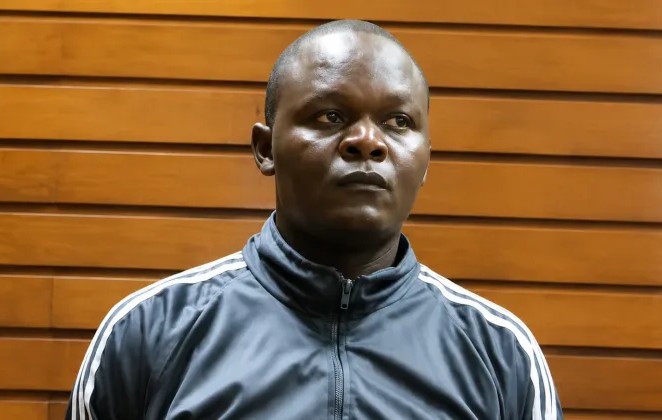
MOMBASA, Kenya—A Mombasa court has acquitted a former Pandya Memorial Hospital clinical officer accused of raping a dialysis patient during a treatment session, ruling that the prosecution failed to prove the case beyond reasonable doubt.
Chief Magistrate Lucas Onyina found Dias Juma Wabwile not guilty of rape and an alternative charge of committing an indecent act with an adult under the Sexual Offences Act.
Wabwile had been accused of unlawfully penetrating an adult patient, identified in the judgment as M.T.K., at Pandya Memorial Hospital in Mvita Sub-County at around 5am on January 31, 2025.
Eight prosecution witnesses testified during the trial, but none witnessed the alleged assault. The complainant died before the hearing began and was therefore unable to give evidence before the court.
The court said her absence had been adequately explained but meant the prosecution was required to rely on strong independent evidence to prove the charges.
Condom and DNA evidence
A key part of the prosecution case was a used condom recovered from a hospital dustbin.
Analysis by the Government Chemist found spermatozoa and generated a male DNA profile matching Wabwile’s DNA sample.
Wabwile admitted that the condom was his but gave the court a different explanation for how it ended up at the hospital. He said he had had sex with his wife, Nancy Gakii, at home at about 3.30am before reporting to work and carried the used condom with him before disposing of it at the hospital.
His wife supported his account, telling the court that the couple had used a condom during sex that morning.
The magistrate, however, questioned aspects of Wabwile’s explanation, including his claim that he had wrapped the condom in tissue paper before carrying it to the hospital.
“If he wrapped it in tissue paper as he stated in his testimony, how come it was not so wrapped at the point of its recovery?” Onyina asked.
The court also considered evidence that the complainant appeared to know that a condom had been discarded and directed nurses to where it was recovered.
Strong suspicion not enough
In the judgment, the magistrate observed that the evidence suggested Wabwile and the complainant may have crossed the boundaries of a professional doctor-patient relationship.
The court also noted that the patient was connected to a dialysis machine and that disconnecting it could result in severe bleeding.
Onyina said the circumstances could support an inference that Wabwile may have taken advantage of the patient’s situation.
However, he stressed that an inference could not replace proof.
“Absence of consent on the part of the complainant cannot be presumed,” Onyina ruled.
The magistrate said that had the complainant survived to testify, she could have told the court whether she consented to the sexual intercourse.
The court also faulted investigators for failing to obtain a DNA sample from Wabwile’s wife despite her evidence that the condom had been used during sex between the couple.
According to the judgment, such a sample could have helped establish whether her account was supported by scientific evidence.
Court: Suspicion cannot support conviction
In assessing the circumstantial evidence, the court relied on the Court of Appeal decision in Sawe v Republic, which requires the prosecution to exclude reasonable explanations consistent with an accused person’s innocence.
Onyina said the evidence created a strong suspicion against Wabwile but fell short of the threshold required for a criminal conviction.
“There is very strong suspicion that the accused, most likely, raped the complainant,” the judgment states.
But the court added:
“Suspicion, however strong, cannot be a basis of a conviction.”
The magistrate said the court could not fill gaps in the prosecution case by speculating about what the deceased complainant might have told the court had she survived.
“The court cannot guess what the complainant would have said, then make a finding on that basis,” Onyina ruled.
The court ultimately found that the evidence, considered as a whole, could not safely establish beyond reasonable doubt that Wabwile had unlawfully penetrated the complainant.
The same reasoning was applied to the alternative charge of indecently touching the complainant, with the court noting the absence of an eyewitness and the complainant’s inability to testify.
Wabwile was consequently acquitted of both charges under Section 215 of the Criminal Procedure Code.
“I find the accused person not guilty of the main charge and the alternative charge,” Onyina ruled.