



















MOMBASA, Kenya—Journalists in Mombasa have called on security agencies to speed up investigations into attacks against media practitioners, warning that delays in delivering justice threaten press freedom and the public’s right to information.
Mombasa Press Club Chairperson Omari Shungu said journalists continue to face intimidation and physical attacks while carrying out their professional duties, with slow investigations raising concerns about accountability.
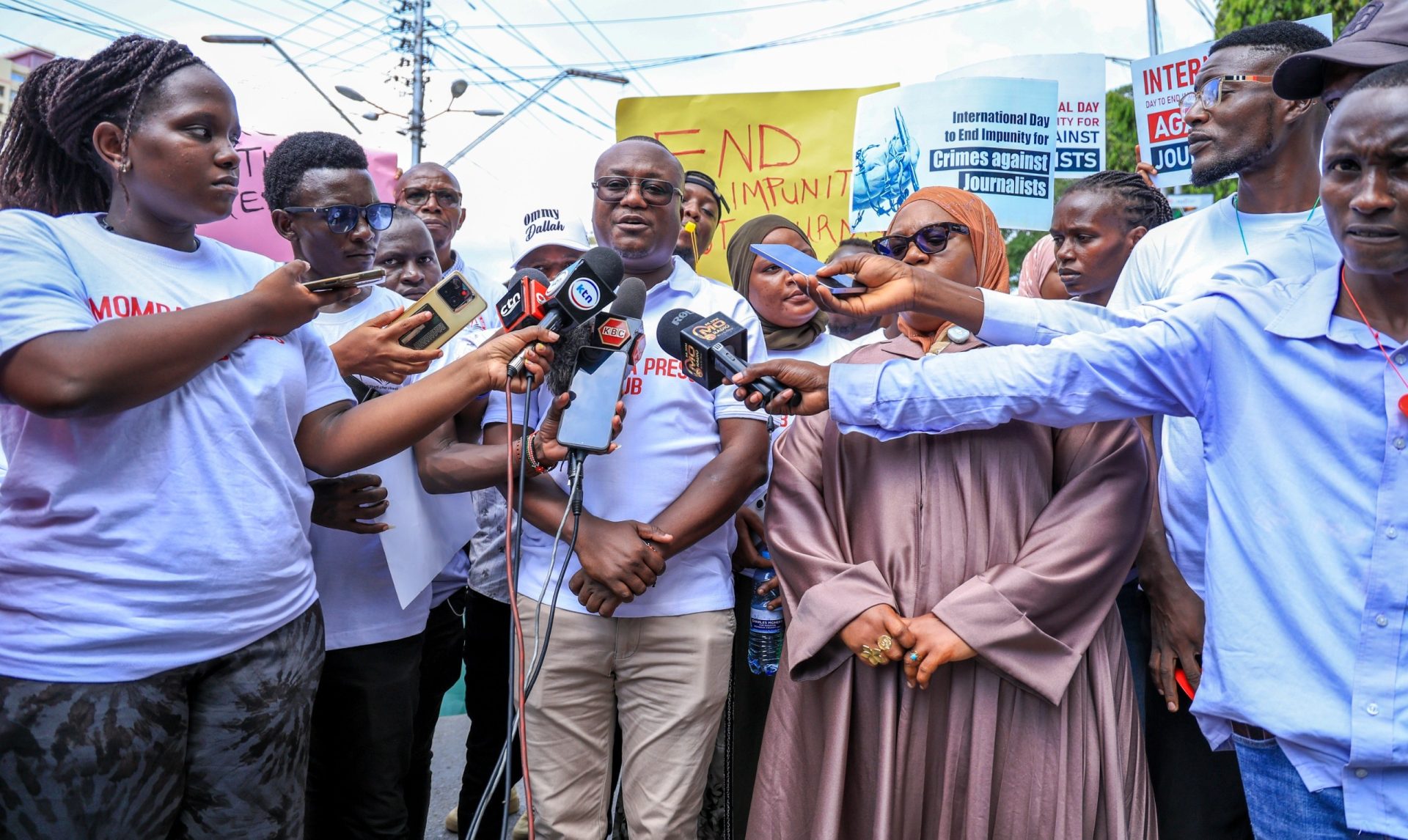
Speaking during celebrations to mark the International Day to End Impunity for Crimes Against Journalists on Monday, Shungu said the annual observance provides an opportunity to push government institutions, security agencies and the judiciary to ensure that perpetrators of attacks against journalists are brought to justice.
He stressed that attacks on journalists affect society beyond the individual victims because they undermine the public’s ability to access information.
“Journalism is not a crime. It is an important profession that serves the interests of society. When you undermine the freedom of a journalist, you are also suppressing the voice of the community,” said Shungu.
He maintained that the Constitution guarantees media freedom and protects journalists’ right to perform their duties without intimidation or interference.
Shungu was speaking during a media freedom awareness walk in Mombasa, which was officially flagged off by nominated Senator Miraj Abdillahi, Vice-Chairperson of the Senate Committee on Information, Communication and Technology.
Abdillahi reaffirmed her support for media freedom, commending journalists for providing verified information and contributing to national development amid growing concerns over misinformation and disinformation.
She observed that the increasing influence of artificial intelligence had made the role of professional journalists even more important in helping the public distinguish credible information from falsehoods.
“In this age of artificial intelligence, misinformation and disinformation are rampant. Nevertheless, journalists remain steadfast in delivering the information that the country and the world require. We appreciate your efforts and stand by you,” she said.
The senator urged security agencies and government leaders to respect journalists and guarantee their safety, particularly as political activities intensify ahead of the 2027 General Election.
She warned that the emerging political environment required vigilance to ensure journalists are not intimidated or subjected to violence while covering political developments.
Abdillahi also urged media organisations to balance their reporting by highlighting constructive stories that inspire young people and promote national unity, without abandoning their responsibility to expose wrongdoing and report crime.
She said coverage of positive developments and opportunities available to young people could help promote hope and discourage divisive narratives, including tribalism.
“We should also broadcast stories that give young people hope that they can become something in this nation. We should tell them that tribalism should be a thing of the past and not something that defines our future,” she said.
She further called on security agencies to recognise the media’s contribution to accountability, noting that journalists have helped expose challenges within security institutions that might otherwise have remained unknown to the public.
Responding to concerns over prolonged investigations into attacks against journalists, Shungu said the Press Club would continue pressing relevant authorities to handle such cases expeditiously.
He acknowledged that investigations fall within the mandate of security agencies but maintained that the media fraternity had a responsibility to demand accountability and stand with journalists whose rights had been violated.
The International Day to End Impunity for Crimes Against Journalists is observed annually on November 2. It seeks to raise awareness about attacks against journalists and promote accountability for crimes committed against media practitioners.
Impunity for such crimes threatens not only media freedom but also democratic accountability and the public’s right to information.