
























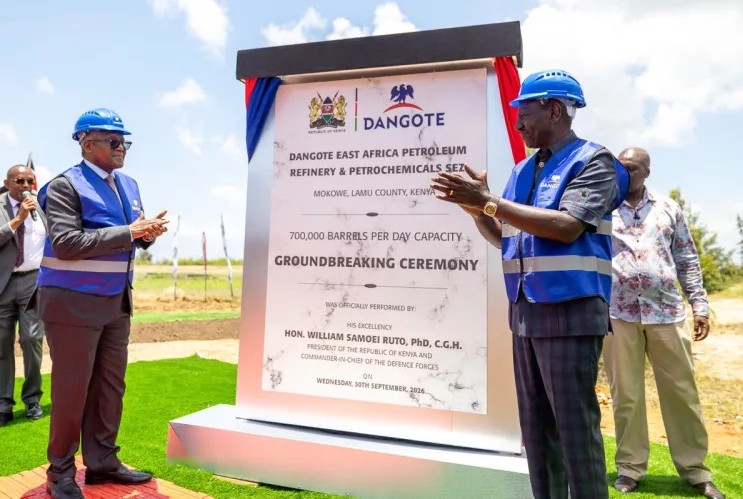
JNN INSIGHT | The proposed Sh2.2 trillion Dangote East Africa Refinery could transform Kenya’s industrial landscape. But as a land dispute proceeds in court and opposition leaders demand disclosure of the project’s ownership and contracts, the government faces a critical test: demonstrating that investment on this scale can proceed alongside transparency and respect for the public interest.
The groundbreaking of the proposed refinery in Lamu on September 30, led by President William Ruto and Nigerian industrialist Aliko Dangote, marked an ambitious step in Kenya’s industrialisation agenda. Designed to process up to 700,000 barrels of crude oil daily, the facility is expected to serve Kenya and the wider East African region. Government officials have presented it as a potential source of jobs, industrial growth and greater energy security.
Yet the project has also opened difficult questions about land rights, ownership, public commitments and the extent to which Kenyans can scrutinise the terms of a development being promoted as nationally transformative.
These are not peripheral concerns. When a project involves thousands of acres, a multitrillion-shilling investment and potential government participation, the public interest extends beyond the promise of construction and employment. It includes knowing who owns the investment, what the state is contributing and what obligations may ultimately fall on taxpayers.
Court process versus land rights
The immediate dispute concerns residents who have challenged the refinery development over land they say is connected to their homes, livelihoods and community interests.
On October 14, the Environment and Land Court in Malindi declined to extend interim restrictions affecting the project. Justice Jane Onyango Muyoti allowed the residents to amend their court papers to include additional complainants and correct details relating to the disputed property. The petitioners were directed to file the amended application within seven days and serve the respondents within the following seven days. The respondents then have ten days to respond, with submissions scheduled for November 24, 2026.
The decision allows preparations to proceed while the legal dispute continues. It does not, however, determine the merits of the residents’ underlying claims. That distinction is essential: a procedural ruling on interim relief is not equivalent to a final judgment on land ownership, compensation or compliance with legal requirements.
The government and project proponents have a legitimate interest in avoiding unnecessary delays to major investment. Residents, equally, have a right to have their claims heard through a fair legal process. Development cannot be assessed solely by the speed with which machinery reaches a site; it must also be assessed by whether land acquisition, compensation and public participation meet the applicable legal standards.
The government has previously said it identified 9,000 acres for the project and was seeking an additional 3,000 acres as the development expands. That makes clarity over the land’s legal status, acquisition process and intended use particularly important.
Documents, not political speculation
The controversy has become more politically charged amid claims by opposition figures that President Ruto has a personal financial interest in the refinery.
Those allegations remain unproven in the material publicly established here. Treasury Cabinet Secretary John Mbadi has explicitly denied that Ruto owns shares in the project. The allegation should therefore not be presented as fact, nor should the minister’s denial be treated as a substitute for disclosure of the project’s ownership records.
The more substantive question is straightforward: who owns the Kenyan company responsible for the project, and what are the respective stakes of the private investors, the Kenyan government and any other participating entities?
People’s Party of Kenya leader Ndindi Nyoro has demanded disclosure of the shareholders and greater clarity on the government’s participation. His questions include the amount of land allocated to the project, whether land will count as an equity contribution and what financial or infrastructure commitments Kenya has made.
These are legitimate matters for public scrutiny, regardless of the political identity of the person raising them. But political claims about hidden interests must be supported by evidence. The appropriate way to resolve uncertainty is through the shareholder register, beneficial ownership records and agreements governing the project—not speculation about who might benefit.
The contract question
The demand for disclosure goes beyond the names of shareholders. It concerns the terms under which the project will operate and the obligations each party has accepted.
A separate petition before the High Court in Nairobi has sought disclosure of agreements and public commitments associated with the refinery. The court certified the petition as urgent, but the substantive questions remain subject to the legal process.
The government should clarify which agreements have been signed, what remains under negotiation, whether public funds or guarantees are involved, how any state contribution will be valued and what tax or other incentives have been granted. It should also explain how public investment, if any, translates into ownership rights, financial returns and exposure to risk.
Commercial confidentiality may protect genuinely sensitive information. It should not become a blanket reason to withhold information about public resources or commitments made in the country’s name. Where some provisions require protection, authorities should explain the legal basis and disclose the remaining information to the fullest extent permitted by law.
Investment against public benefit
The refinery’s proponents anticipate employment, industrial expansion, regional trade and improved energy security. These benefits could be significant, but their scale will depend on how the project is financed, constructed and operated. The claim that the refinery will reduce fuel prices, in particular, should be treated as a potential outcome rather than a guaranteed benefit.
For Lamu residents, accountability means clarity over land and livelihoods. For taxpayers, it means understanding public contributions and financial risks. For investors, transparent agreements and clear land rights can reduce uncertainty. For the government, disclosure offers a way to demonstrate that the project is being pursued on a sound and lawful basis.
Kenya does not have to choose between attracting major investment and demanding accountability. Both objectives can be pursued together.
The Dangote refinery may become a landmark in the country’s industrial development. But its significance should not be measured only by its capacity or the size of the investment. It should also be measured by whether land claims receive due process, ownership questions are answered with evidence and the public can understand the commitments being made on its behalf.
For a project of this magnitude, transparency is not an obstacle to development. It is part of the test of whether development serves the public interest.