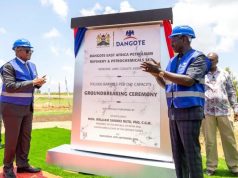























President William Ruto is presenting the planned East Africa Refinery in Lamu as a Sh2 trillion investment that could create about 60,000 jobs, strengthen regional energy security and transform the Coast into a major petroleum and industrial hub.
But as the government prepares for Wednesday’s September 30 groundbreaking, the ambitious project is facing a legal challenge from 133 residents who say their ancestral land is being taken over without adequate compensation and due process.
The competing narratives place the refinery at a critical juncture: the government is preparing to launch what it describes as a transformative regional investment, while affected residents are asking the courts to stop activities on land they say their families have occupied, cultivated and developed for generations.
Ruto said the groundbreaking would mark a major step in opening up the Coast to large-scale investment and addressing what he described as decades of marginalisation.
“We will have a refinery that will unite at least eight countries which will be constructed in Lamu and give us a chance for investment of about Sh2 trillion and give employment opportunities of 60,000,” the President said while in Lunga Lunga, Kwale County, during a title-deed issuance exercise.
He said the project would also help Kenya earn foreign exchange by reducing reliance on imported refined petroleum products while supplying markets across the region.
“On Wednesday this week, we will do the historic groundbreaking in Lamu and this will serve as a testament that the coastal region will not be left behind and the marginalisation that has happened for decades will not continue,” Ruto said.
A refinery for the region
The proposed refinery at Kililana in Lamu West is planned to process up to 700,000 barrels of crude oil per day, making it one of the largest planned refining facilities on the continent.
The government says it will supply petroleum products to Kenya and seven other regional markets — Uganda, Tanzania, Rwanda, Burundi, South Sudan, Ethiopia and the Democratic Republic of Congo.
The refinery is therefore being positioned as more than a Kenyan facility, with the government seeking to establish Lamu as a regional petroleum-processing and industrial centre.
The project is also expected to strengthen the strategic role of the Lamu Port-South Sudan-Ethiopia Transport (LAPSSET) corridor, with petroleum storage, logistics, manufacturing and other industrial activities expected to develop around the refinery.
Plans associated with the wider development include a special economic zone and a proposed 1,000-megawatt power plant to support industries expected to emerge around the facility.
Deputy President Kithure Kindiki has projected more than 50,000 jobs, while Ruto has put the employment opportunity at about 60,000. The wider figure is expected to include jobs generated directly and through associated economic activities.
Construction moves closer
The refinery is no longer only a proposal on paper.
The vessel MV Da Yang Bai He docked at Lamu Port over the weekend carrying about 2,930 metric tonnes of construction materials and heavy equipment destined for the project.
The arrival has been described as a major step towards construction ahead of the groundbreaking ceremony.
Ruto also toured the existing Dangote refinery in Lagos, Nigeria, after meeting Nigerian industrialist Aliko Dangote and Africa Finance Corporation Chief Executive Officer Samaila Zubairu in New York to discuss financing and preparations for the Kenyan project.
The Lagos refinery has a design capacity of 650,000 barrels per day, compared with the proposed 700,000 barrels per day for Lamu.
The Kenyan project is expected to process crude from Kenya and the wider region. However, questions around the availability and transportation of sufficient crude remain important as the project moves towards construction and eventual operation.
Land dispute clouds groundbreaking
While preparations for the ceremony gather pace, the land question has emerged as a major point of contention.
The 133 Chandavai residents have moved to court seeking to stop what they describe as the unlawful takeover and destruction of land they say their families have occupied and used for generations.
The residents have sued the Office of the President, the Cabinet Secretary for Defence, the State Department for Lands and Physical Planning, the Attorney General, the National Land Commission, LAPSSET Corridor Development Authority and the Lamu County Government.
Dangote Industries and two companies identified as contractors have also been named as defendants.
In their court papers, the residents say they have traditionally used the disputed land for farming and livestock keeping and have established homes, mosques, shrines and other structures.
They want the court to stop activities that could lead to the destruction of crops, trees, homes and other property pending determination of the dispute.
The case does not determine the legality of the refinery or the government’s land-acquisition process. Those questions will now be considered through the court process.
Who benefits?
Beyond the court case, the project is raising another important question in Lamu: how much of the promised economic opportunity will reach local communities?
The government has presented the refinery as an anchor investment capable of attracting additional industries, creating employment and positioning Lamu as a regional energy hub.
Local leaders and residents, however, have called for local communities to benefit through jobs, procurement opportunities, skills development and new businesses.
That concern reflects a wider debate around major infrastructure projects on the Coast, where communities hosting national investments often seek tangible economic benefits alongside development.
For Lamu, the stakes are particularly high.
The county is already central to the LAPSSET corridor and hosts the country’s strategic Lamu Port. A multibillion-shilling refinery could significantly reshape the county’s economic landscape if the government’s projections are realised.
But the project’s success will depend on more than the size of the investment or the number of dignitaries attending Wednesday’s ceremony.
It will also depend on whether the promised jobs and economic opportunities materialise, whether sufficient crude can be secured, whether financing and construction proceed as planned, and whether the concerns raised by affected communities are addressed through lawful and transparent processes.
As the first construction equipment arrives and the government prepares to break ground, the refinery is moving closer to reality.
For the government, it represents a chance to transform Lamu into a major regional energy and industrial centre.
For the 133 residents before the courts, the immediate question remains whether that transformation can proceed on land they say has been home to their families for generations.