



















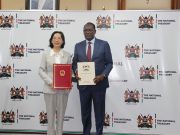





MOMBASA, Kenya— Coast Development Authority Chairperson Mzee Mwinyi has opposed a proposed law seeking to dissolve Kenya’s six Regional Development Authorities, warning that the move could undermine coordinated regional development and efforts to unlock the country’s economic potential.
Mwinyi said the authorities remained important in coordinating shared resources, promoting cross-county projects and complementing county governments in addressing development challenges that extend beyond individual county boundaries.
Speaking ahead of a public participation forum for the Coast region on the Regional Development Authorities Laws (Repeal) Bill, 2026, he argued that Kenya needed stronger regional development coordination rather than the dismantling of institutions established to facilitate it.
The National Assembly Departmental Committee on Regional Development is conducting nationwide public participation on the Bill, which proposes the dissolution of the country’s six Regional Development Authorities.
They include the Coast Development Authority (CDA), Kerio Valley Development Authority, Lake Basin Development Authority, Tana and Athi Rivers Development Authority, Ewaso Ng’iro South River Basin Development Authority and Ewaso Ng’iro North River Basin Development Authority.
Under the proposed legislation, the authorities’ assets and liabilities would be transferred to the State Department for the National Treasury. Their loans, credit facilities and other financial obligations would also be transferred or enforced against the department.
Employees of the authorities would be transferred to the Public Service Commission under terms and conditions no less favourable than those they enjoyed immediately before the transition date.
However, Mwinyi maintained that the institutions should be assessed on their contribution to economic growth, livelihoods, environmental protection and the efficient use of public resources before any decision is made on their future.
“RDAs are not a luxury but a constitutional and economic necessity for Kenya’s shared prosperity,” he said.
Coast Economy
Making the case for retaining the authorities, Mwinyi pointed to the Coast region’s rich natural and economic resources, including access to the Indian Ocean, agricultural land, fisheries, livestock, forests, minerals, tourism attractions and cultural heritage.
He said these resources presented significant opportunities for industrialisation, employment creation and improved household incomes but argued that their potential had yet to translate into the levels of prosperity and economic independence residents deserved.
“We must therefore return to the fundamental question of development: how do we convert what we have into what our people need?” Mwinyi said.
He identified coordinated investment, value addition, technology and good governance as essential to building a diversified and productive regional economy.
The CDA chairman added that, if adequately resourced, the authority could help the Coast region adapt to technological change while strengthening its economic resilience.
Complementing County Gov’t
Mwinyi also sought to distinguish the role of regional development authorities from that of county governments, maintaining that the CDA was not intended to replace devolved administrations or duplicate their constitutional functions.
Instead, he said, its value lay in coordinating shared resources, facilitating projects involving multiple counties and bringing regional priorities together under a common development agenda.
“CDA does not exist to replace county governments, undermine devolution or duplicate the constitutional functions of counties,” he said.
He called for greater cooperation among political leaders, county governments and development institutions, arguing that competing institutional interests should not take precedence over residents’ needs.
“The Coast does not need development driven by political rivalry or competing institutional interests. It needs leaders and institutions that can work together around shared priorities,” Mwinyi said.
“Our people must be placed above institutional egos, political divisions and jurisdictional competition.”
The nationwide public participation process provides an opportunity for stakeholders to present their views on the proposed dissolution and the future management of the authorities’ assets, liabilities, employees and development functions.
The committee’s recommendations and the subsequent legislative process will determine the Bill’s next steps.