
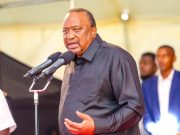






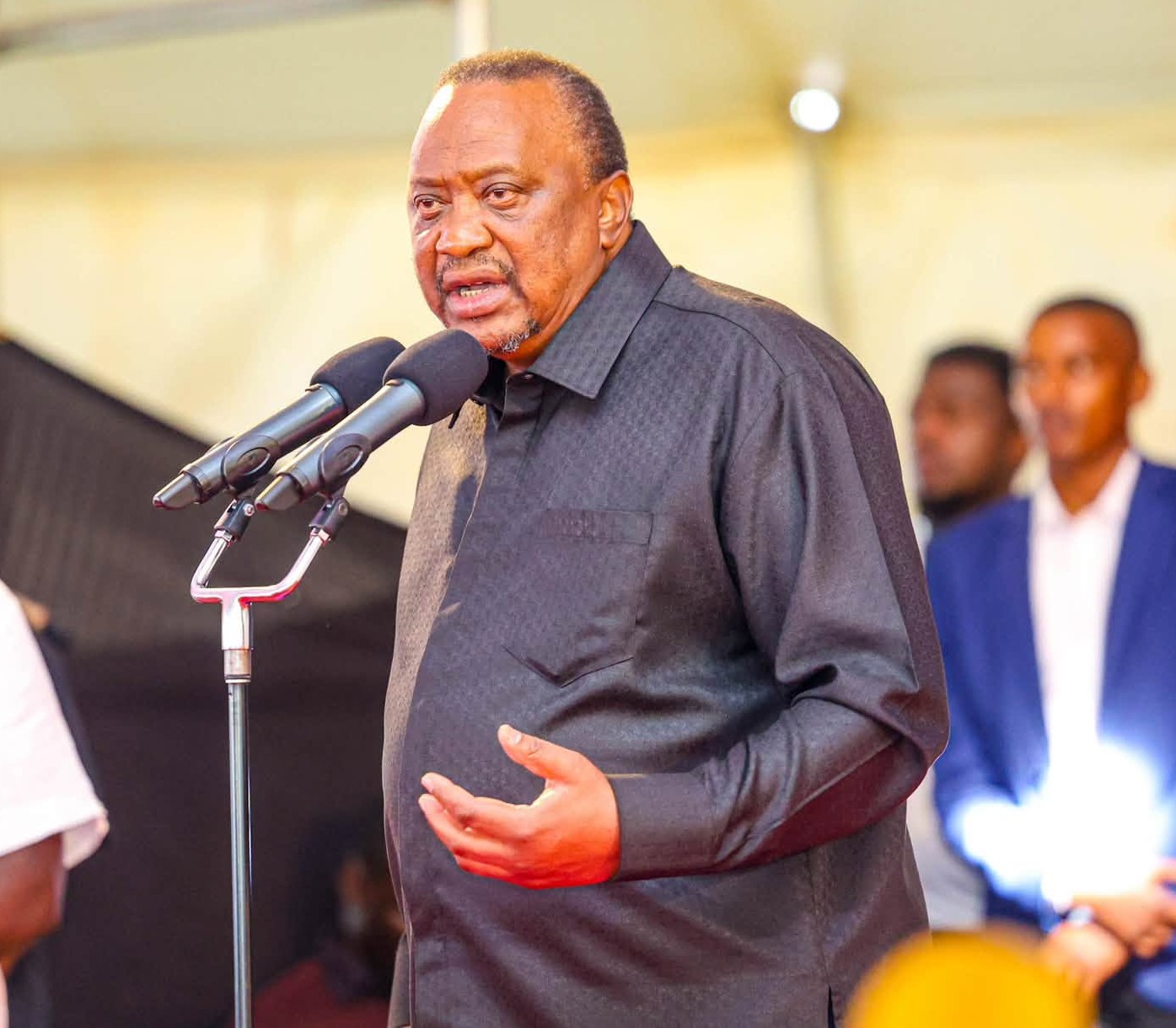
KIRINYAGA, County—Retired President Uhuru Kenyatta has hit back at President William Ruto over sustained criticism against him, telling his successor that he is wasting his time attacking a former Head of State who has no interest in seeking another elective position.
Kenyatta said he was unfazed by the attacks and reminded Ruto that his time as President had already come and gone.
“You are wasting my time abusing me, I have nothing to lose and I thank God for my time as president,” Kenyatta said on Saturday during the burial of Mwalimu Jackson Karua, father of People’s Liberation Party leader Martha Karua, in Gichugu, Kirinyaga County.
The former President also questioned calls by political leaders for restraint in political discourse, saying such appeals should equally apply to those attacking their opponents.
The exchange marks another escalation in the increasingly open political confrontation between Kenyatta and Ruto as political alignments begin taking shape ahead of the 2027 General Election.
Ruto has repeatedly accused his predecessor of backing opposition politicians and movements seeking to undermine his administration, with the President recently describing some of his opponents as being sponsored to oppose government programmes.
Kenyatta has rejected the accusations and has maintained that he is not seeking a return to elective politics.
At Saturday’s funeral, however, the retired President went beyond simply responding to the attacks, telling his former political base in the Mt Kenya region not to repeat what he described as the mistake of supporting Ruto in the 2022 election.
enyatta reminded residents that he had backed the opposition ticket of Raila Odinga and Martha Karua in the 2022 presidential election, but the region largely supported Ruto, who defeated Odinga in the closely contested poll.
He said Kenyans could make mistakes but should not repeat them, effectively turning the funeral gathering into another platform for political mobilisation ahead of the next election.
The remarks came as several opposition leaders gathered around Karua, with calls for political parties and leaders opposed to Ruto to unite and settle on a common presidential candidate for 2027.
The political significance of Kenyatta’s intervention has been heightened by a changing legal position on the role former presidents can play in active politics.
In September, the High Court delivered two conflicting judgments on whether retired presidents can hold formal positions in political parties beyond six months after leaving office.
On September 14, Justice Lawrence Mugambi upheld Section 6 of the Presidential Retirement Benefits Act, which bars a retired president from holding a leadership position in a political party more than six months after leaving State House.
The ruling directly affected Kenyatta, who had continued serving as Jubilee Party leader after retiring from the presidency in September 2022. Following the judgment, Kenyatta indicated that he would step down from the party leadership.
A week later, however, Justice Bahati Mwamuye declared the same restriction unconstitutional, ruling that leaving the presidency does not strip a former Head of State of constitutional political rights.
Justice Mwamuye held that a retired president becomes a private citizen after leaving office and remains entitled to the political rights guaranteed under the Constitution. The ruling struck down the statutory restriction on holding political party office beyond six months.
The conflicting decisions have therefore created a fresh legal dimension to the debate over the political role of former presidents, particularly at a time when Kenyatta has become increasingly vocal in national politics.
The dispute between Kenyatta and Ruto has its roots in the dramatic collapse of their political partnership after the 2013 and 2017 elections.
The two were elected President and Deputy President respectively in 2013 and secured a second term in 2017 under the Jubilee Party. Their relationship deteriorated during Ruto’s second term as deputy president, particularly after Kenyatta began working with opposition leader Raila Odinga under the 2018 handshake arrangement.
The political split became complete during the 2022 election, when Kenyatta backed Odinga and selected Karua as his running mate, while Ruto ran against the administration he was serving as deputy president.
Ruto eventually won the election and succeeded Kenyatta as President, but the rivalry between the two political camps has continued into the current electoral cycle.
Ruto has since accused sections of the former administration of contributing to economic and governance problems inherited by his government, while Kenyatta has increasingly challenged the President over his record and political conduct.
The latest exchange therefore comes against a broader contest over political influence, particularly in the Mt Kenya region, where Ruto secured substantial support in 2022 but where opposition leaders are now seeking to rebuild their presence.
Saturday’s gathering in Kirinyaga brought together several prominent opposition figures, including former Vice President Kalonzo Musyoka, Martha Karua, Fred Matiang’i, Edwin Sifuna and other leaders seeking to build a united political front against Ruto.
The leaders used the occasion to renew calls for opposition unity and a single presidential candidate, although questions remain over who would lead such a coalition and whether the various parties can overcome their competing ambitions.
For Kenyatta, the latest confrontation with Ruto also provides an opportunity to reassert his political influence without formally seeking elective office.
For Ruto, the former President remains a significant figure in the political contest over Mt Kenya and the wider opposition landscape as his administration approaches the second half of its first term.
With the 2027 election approaching, the increasingly direct exchanges between the two former allies are likely to remain a feature of Kenya’s political debate as parties and leaders position themselves for the next presidential contest.