














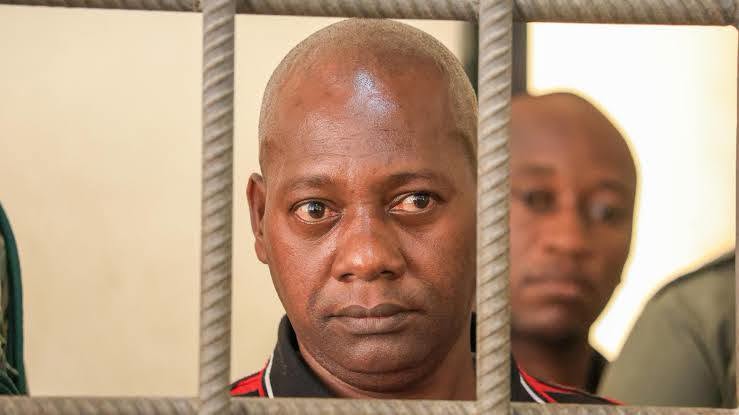
MOMBASA, Kenya—The High Court has convicted self-proclaimed pastor Paul Nthenge Mackenzie and 28 co-accused of the murder of 191 people, including 190 children, in the Shakahola starvation cult case, bringing a major chapter of one of Kenya’s deadliest tragedies to a close.
In a judgment delivered on Monday, October 19, Lady Justice Diana Kavedza rejected the defence argument that the victims had voluntarily fasted to death, finding that the prosecution had proved its case against all the accused.
“I am satisfied that the prosecution has proved the case against all the 29 accused persons for the murder of 190 children and one adult contrary to Section 203 of the Penal Code,” the judge ruled.
“I reject the defence by the accused persons that the victims, who were all below the age of 16 years, voluntarily fasted to death.”
The court subsequently convicted all 29 accused under Section 322 of the Criminal Procedure Code. One of the accused had earlier pleaded guilty to all the counts and was convicted on that plea, with sentencing still pending.
Justice Kavedza directed that all the convicts be produced physically in court on November 6, when sentences will be delivered.
Pre-sentence reports
Before sentencing, the court ordered the Probation and Aftercare Services to assign each convict an individual probation officer to prepare separate pre-sentence reports.
The reports are expected to be filed by October 30, after which the defence will present mitigation before the court determines the appropriate sentences.
The judge also confirmed that the court had received 68 victim impact statements prepared by probation officers from across the country, saying the statements had already been taken into account and would not be repeated during the mitigation stage.
The Shakahola tragedy
The case stems from the Shakahola Forest tragedy in Kilifi County, where followers of Mackenzie’s Good News International Church were alleged to have been subjected to extreme fasting practices under religious teachings that prosecutors argued ultimately led to widespread deaths.
The discoveries shocked the country after authorities began exhuming bodies from mass graves in April 2023, triggering one of Kenya’s largest forensic recovery operations involving police investigators, pathologists, DNA experts and other government agencies.
The prosecution argued that Mackenzie, also known as Mtumishi, Nabii and Papaa, radicalised followers through extremist religious teachings and promoted fasting as a pathway to salvation.
During the trial, prosecutors relied on the doctrine of common intention, arguing that the accused acted together in a shared plan that led to the deaths.
The case featured testimony from survivors, relatives of victims, investigators and forensic experts, alongside postmortem findings, DNA evidence and other forensic material collected during the investigations.
In April this year, Justice Kavedza ruled that Mackenzie and his co-accused had a case to answer, finding that the prosecution had established a prima facie case before placing them on their defence.
Wider failures exposed
The murder case concerns 191 victims whose deaths formed the basis of the charges before the High Court. However, the wider Shakahola tragedy has involved hundreds more victims whose deaths and disappearances have been documented through broader investigations.
The Kenya National Commission on Human Rights (KNCHR), in its Mashaka ya Shakahola report released in March 2024, documented 448 deaths linked to the tragedy and reported that more than 600 people remained missing.
The commission said fewer than 10 per cent of the recovered bodies had been identified and returned to families for burial.
KNCHR further reported that autopsies pointed to starvation as the leading cause of death in many cases, while other victims showed evidence of strangulation, dehydration and blunt-force injuries. The commission also criticised state agencies for failing to act on earlier warnings about Mackenzie’s activities.
Separate cases continue
Although Monday’s judgment marks a major milestone in the murder trial, it does not conclude all legal proceedings involving Mackenzie and his associates.
Separate criminal cases relating to organised crime, radicalisation and other alleged offences remain before the courts, including proceedings in wich Mackenzie and numerous co-accused were earlier placed on their defence.
The convictions in the murder case nevertheless represent one of the most significant judicial developments arising from the Shakahola tragedy, a case that forced Kenya to confront difficult questions about religious extremism, child protection, institutional accountability and the exploitation of vulnerable followers.
The court is expected to pronounce sentence on November 6.