

















NAIVASHA, Nakuru County—The political partnership between President William Ruto’s United Democratic Alliance (UDA) and the Orange Democratic Movement (ODM) is entering a critical phase as competing interests within the broad-based arrangement begin to collide with the realities of the 2027 General Election.
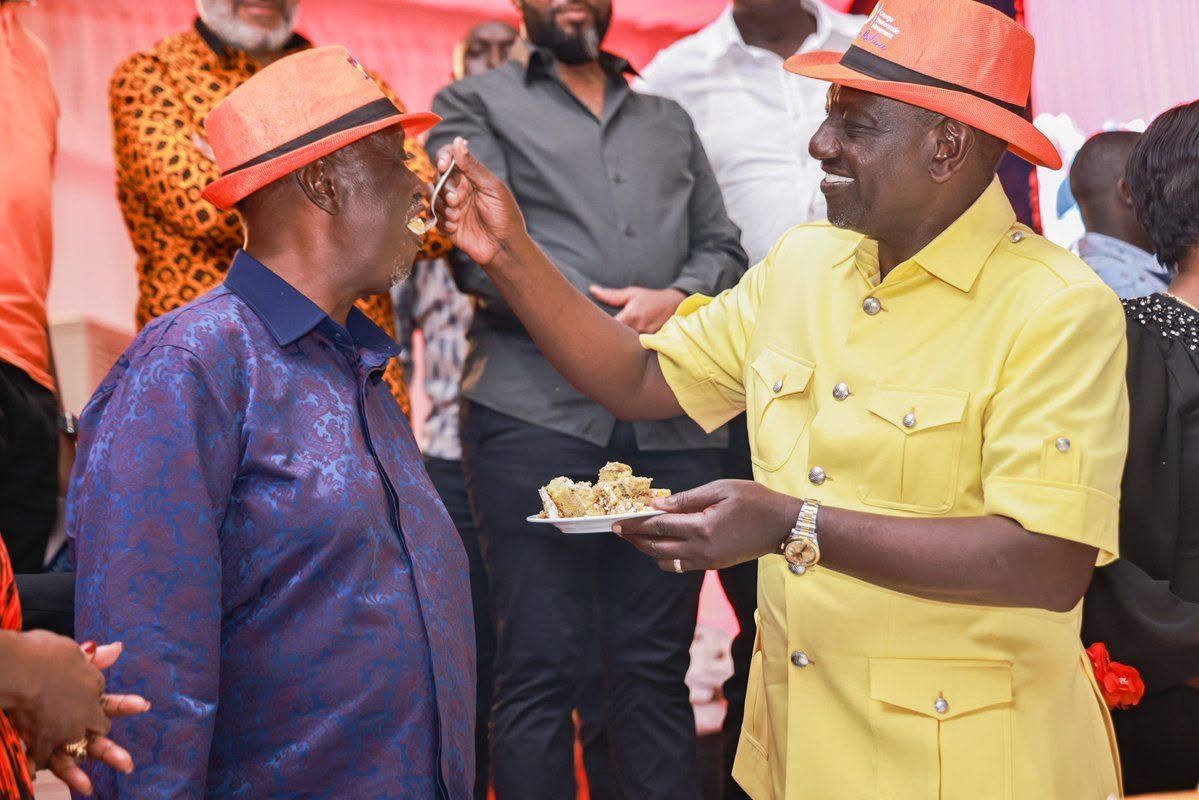
The meeting between Ruto and ODM leader Dr Oburu Oginga in Naivasha comes at a time when the alliance is facing growing pressure from politicians seeking clarity on its future, particularly over the distribution of political positions and the question of who will occupy the Deputy President’s position if Ruto seeks a second term.
What began as a political accommodation between former rivals has gradually evolved into a working arrangement in government. Senior ODM figures have taken up positions in the administration, while leaders from the two political formations have increasingly shared platforms and defended the broad-based approach as an avenue for national stability.
But beneath that cooperation, the political calculations for 2027 are already taking shape.
The Naivasha meeting therefore comes at a delicate moment for both sides, with the two party leaders expected to confront some of the disagreements that have begun emerging within the arrangement and explore how the partnership can be managed without triggering an early political fallout.
The discussions are also expected to examine the implementation of proposals associated with the National Dialogue Committee (NADCO), which played a significant role in creating the political understanding between Ruto and the late Raila Odinga.
The NADCO process addressed a range of governance and institutional questions, including proposals for the establishment of the offices of Prime Minister and Official Leader of the Opposition.
How those recommendations are eventually handled could become an important measure of the political trust between UDA and ODM, particularly among ODM supporters who regard the implementation of the dialogue proposals as part of the broader understanding that brought the two sides together.
The Deputy President question
Yet it is the 2027 succession calculations that could prove far more difficult to contain.
Sections of ODM have increasingly pushed the argument that the Deputy President’s position should form part of the political bargain, with Cooperatives Cabinet Secretary Wycliffe Oparanya emerging as one of the names being promoted as a possible running mate for Ruto.
That proposition has the potential to unsettle political forces associated with Deputy President Kithure Kindiki, whose allies are expected to resist any attempt to remove their side from the succession equation.
The disagreement is significant because the Deputy President position is not merely another political appointment. It is potentially the most visible indicator of which faction has secured the strongest bargaining position within the alliance.
For ODM, demanding a meaningful stake in the 2027 presidential ticket would be consistent with the argument that the party’s cooperation with Ruto must eventually translate into political power.
For UDA, however, conceding the position could mean asking a section of its political base to surrender one of the most important elements of the 2027 succession calculations.
That is where the alliance’s real test begins.
From cooperation to competition
The relationship between UDA and ODM has been relatively easier to manage while the two parties have been concentrating on governance.
The challenge becomes considerably greater when politicians begin asking who gets what in the next election.
Political alliances in Kenya have historically been tested not only by ideology or policy differences, but by negotiations over positions, constituencies and electoral influence.
The UDA-ODM arrangement is unlikely to be different.
ODM has been pushing for some form of political zoning, with the argument that cooperation should include mutual recognition of areas where either party has traditionally enjoyed significant support.
The proposal would potentially allow the two parties to avoid directly competing against each other in selected political strongholds.
UDA, however, has maintained that political parties should remain free to compete for elective positions across the country.
That difference could become increasingly difficult to manage as the 2027 nominations approach.
The disagreement is particularly significant because ODM will want to protect its traditional political influence while demonstrating to its supporters that joining the broad-based administration has not weakened its independent political identity.
UDA, meanwhile, faces the challenge of maintaining its political machinery and electoral networks while accommodating a partner that was once its principal opponent.
The regional equation
The succession debate also carries a strong regional dimension.
Political leaders are already positioning themselves around the question of who will occupy key positions in a future administration, while different regions are seeking assurances about their place in the emerging political arrangement.
This makes the Deputy President debate much bigger than the ambitions of Oparanya, Kindiki or any other individual politician.
It is becoming a contest over regional representation, political influence and access to power after 2027.
The longer the question remains unresolved, the greater the likelihood that competing factions will begin mobilising independently.
That could gradually transform what is currently an internal disagreement into an open contest within the broader alliance.
A partnership with two audiences
Perhaps the biggest challenge facing Ruto and Oburu is that they are dealing with two different audiences.
At the national level, they have an interest in presenting the broad-based government as stable and capable of delivering on governance and development.
Within their respective parties, however, they must respond to politicians whose primary concern is the 2027 election. That creates a delicate balancing act.
A decision that strengthens the national partnership could weaken one party’s bargaining position internally. Conversely, a concession designed to satisfy party activists could destabilise the broader political arrangement.
This is why the Naivasha talks matter. They offer the two sides an opportunity to establish political ground rules before succession politics becomes completely dominant.
Is the alliance built to last?
The fundamental question now confronting the broad-based arrangement is whether it can transition from a governing partnership into an electoral coalition.
It is possible for rival political formations to work together in government while retaining separate electoral ambitions. But once the 2027 campaign begins in earnest, questions about presidential tickets, running mates, constituencies and party nominations become unavoidable.
The political accommodation between Ruto and the late Raila Odinga fundamentally altered Kenya’s post-2022 political landscape.
Senior ODM figures are now part of government, while UDA has gained an important political partner that was previously positioned firmly in the opposition.
But political partnerships are ultimately tested at the point where interests collide.
And that point is approaching.
The Naivasha discussions therefore represent more than an ordinary political retreat. They could provide an early indication of whether UDA and ODM are capable of negotiating their differences before the 2027 succession battle reaches its most intense stage.
For Ruto, the challenge is to preserve the broad-based alliance without losing the political support that brought him to power in 2022.
For ODM, the challenge is to secure a meaningful stake in the emerging political order without surrendering the party’s identity or bargaining power.
And for politicians such as Kindiki and Oparanya, the unfolding succession debate represents an opportunity to establish themselves before the presidential contest takes definitive shape.
The question is no longer whether UDA and ODM can work together. They already are.
The real question is whether they can agree on how to share power when the ballot box becomes the ultimate test of their partnership in 2027.