




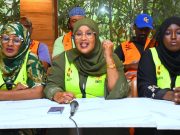

















Nairobi, County—Civil society organisations and stakeholders have called on the government to declare gender-based violence (GBV), including femicide, a national crisis, citing a sharp rise in killings and violence against women and girls across Kenya.
In a joint statement issued on Wednesday, the organisations said the country was facing a “crisis-level” emergency that requires immediate national intervention.
The groups condemned the increasing number of brutal killings targeting women, noting that many victims have been assaulted, dismembered, burned, or killed by intimate partners and family members.
Among the recent cases highlighted was the death of Sylvia Kemunto, a first-year student at Multimedia University, who was found dead in a water tank in April 2025 after reportedly being strangled. Her boyfriend later surrendered to the police.
The statement also referenced the April 2026 killing of Anita, who was allegedly stabbed to death by her husband, a senior Kenya Defence Forces officer, in front of their four-year-old daughter and a house manager.
In another case, 21-year-old Rose Benter Apondi, a student at Ramogi Institute of Advanced Technology, was reportedly murdered by her ex-boyfriend in what was described as a revenge attack.
The organisations further cited the death of gospel musician Rachel Wandeto, who succumbed to injuries at Kenyatta National Hospital after she was allegedly attacked, doused in petrol, and set on fire by unknown assailants in May 2026.
“We share these stories to represent the many women who have been victims of femicide,” the statement read. “No family should have to endure such pain.”
According to data shared by FIDA-Kenya, 35 out of 70 cases reported weekly across its three offices in 2026 involve physical and sexual gender-based violence committed by intimate partners.
The groups also cited Amnesty International Kenya data from April 2026, indicating that at least eight femicide cases are reported every week in Kenya, translating to nearly one woman or girl killed daily.
Women aged between 18 and 35 account for 59 per cent of femicide victims nationally, with many of the victims being students in institutions of higher learning.
The organisations said most perpetrators are intimate partners or family members, with many incidents occurring within homes. They added that many victims had previously reported threats, abuse, or fears for their safety to relatives, police officers, or community leaders but received little or no protection.
The statement further criticised the lack of proper classification of femicide cases, noting that killings are often recorded as general homicides without recognising the gender-based motive behind the crimes.
While acknowledging existing legal protections under the Constitution and laws such as the Sexual Offences Act and the Protection Against Domestic Violence Act, the organisations argued that weak enforcement has allowed violence against women to persist.
The groups also acknowledged President William Ruto for establishing the Technical Working Group on Gender-Based Violence and Femicide, whose report was launched on January 26, 2026. However, they accused the government of failing to implement key recommendations, including officially declaring GBV and femicide a national crisis.
The coalition issued a series of demands to be addressed within 40 days.
Among the key demands are the declaration of GBV and femicide as a national crisis, the establishment of a dedicated GBV fund, the publication of implementation reports by relevant ministries, and the creation of rapid response systems for survivors and victims’ families.
The organisations also called for a nationwide public awareness campaign on GBV and femicide, alongside improved police investigations, specialised GBV units, and enhanced training for law enforcement officers handling sexual and gender-based violence cases.
They warned that failure by the government to act within the stated timeline would trigger nationwide peaceful protests and strategic public interest litigation aimed at compelling the state to fulfil its constitutional obligations to protect women and girls.
The groups urged the national and county governments, security agencies, civil society organisations, faith-based institutions, the private sector, and the public to work together to address the crisis.
“Every delay means another tragedy that could have been avoided,” the statement said.