






















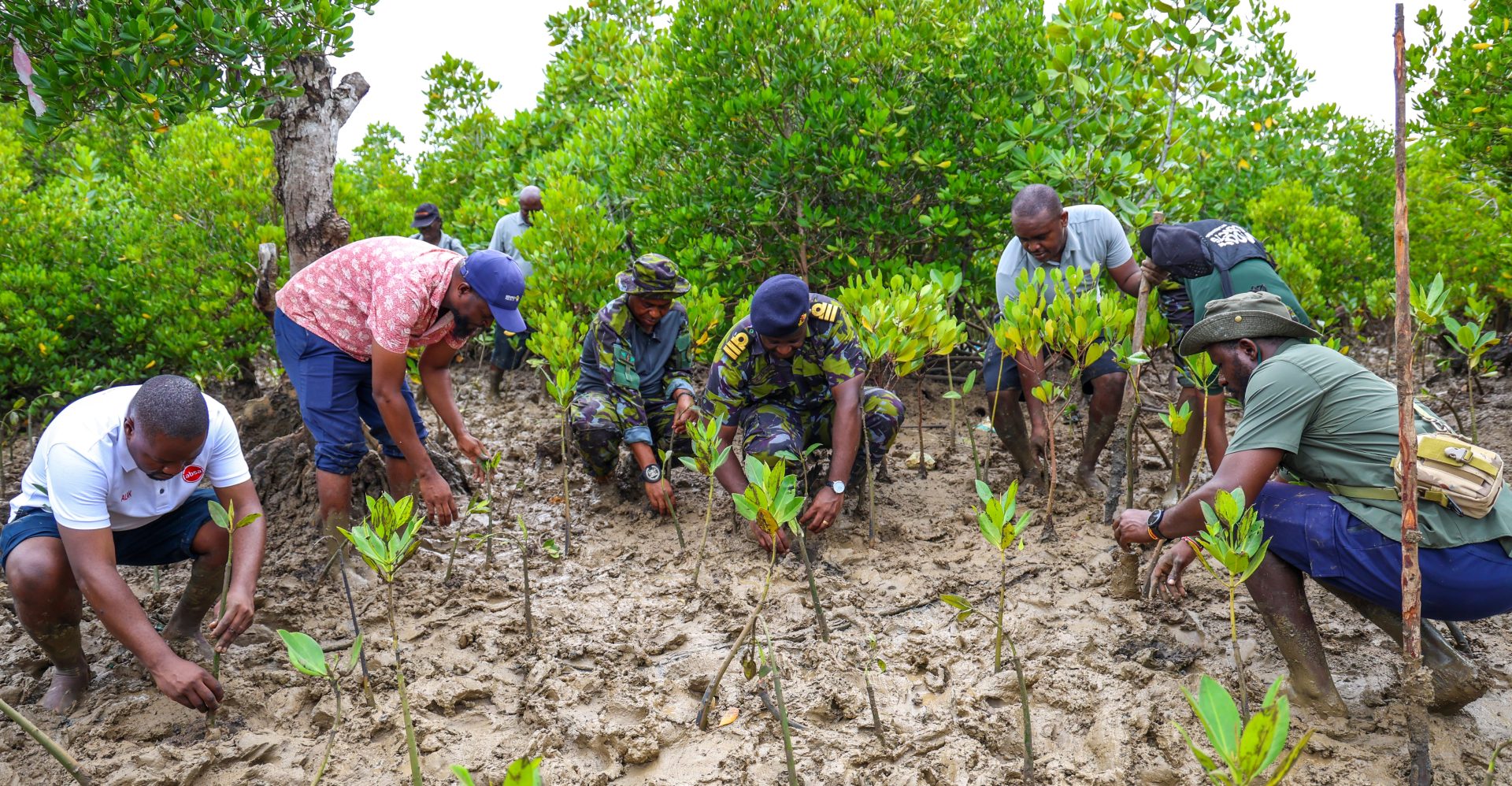
Along the muddy shores of Tsunza in Kwale County, groups of volunteers move carefully through knee-deep wetlands, planting fragile mangrove seedlings under the unforgiving coastal sun. Each seedling pressed into the mud represents more than environmental conservation, it is part of a growing movement to protect Kenya’s coastline, fight climate change and secure livelihoods for future generations.
The mangrove restoration campaign, spearheaded by the Kenya Navy together with conservation groups, private companies and local residents, reflects the increasing urgency surrounding the disappearance of mangrove forests along Kenya’s coast.
For decades, mangroves have quietly protected coastal communities from strong tides, erosion and flooding while supporting marine ecosystems that thousands of families depend on for survival. But rapid urbanisation, illegal logging and environmental degradation continue to threaten these critical forests.
Now communities are fighting back.
“We are here today to plant mangroves together with our key partners and the community at Tsunza,” said Lieutenant Colonel Boniface Amimo of the Kenya Navy during a large-scale planting exercise that saw more than 10,000 seedlings planted in a single day.
The initiative forms part of Kenya’s broader environmental restoration agenda under the national programme targeting 15 billion trees by 2032.
Under directives from President William Ruto, the Kenya Defence Forces (KDF) has increasingly taken an active role in environmental conservation activities across the country.
Lieutenant Amimo said the Kenya Navy is targeting to plant eight million seedlings during the 2025/2026 financial year, including mangroves, indigenous trees and fruit trees.
“So far we have reached around 3.2 million seedlings,” he said.
Environmental experts describe mangroves as one of nature’s most powerful weapons against climate change because of their ability to absorb and store large amounts of carbon dioxide from the atmosphere.
Beyond carbon capture, mangroves also act as natural barriers against coastal erosion and serve as breeding grounds for fish and marine species that sustain local fishing economies.
Conservationists warn that the destruction of mangrove ecosystems has already exposed many coastal communities to rising sea levels, stronger flooding and declining fish stocks.
“For us, mangroves are not just trees,” said Sakwa James of Furaha Baraka Farms, one of the organisations supporting the restoration exercise.
“They protect the environment, absorb huge amounts of carbon and also help communities survive,” he added.
According to the organisation, nearly three million mangroves have already been planted in Tsunza and neighbouring areas over the last two years.
The restoration drive is also attracting growing interest from the private sector as companies increasingly align themselves with climate action initiatives.
Samuel Muthomi from First Assurance said businesses must play a greater role in protecting the environment as climate-related disasters continue to intensify.
“We need to do this as frequently as possible because we are one with nature,” he said.
Brian Hamadi of Absa Life Assurance Kenya described mangrove conservation as both an environmental and economic investment.
“Trees are money,” he said. “By planting mangroves, we are trying to capture as much carbon as possible while also helping communities create livelihoods.”
For many residents in coastal villages, mangrove restoration has become more than a conservation project. It is now an economic lifeline.
A local resident involved in the exercise Khadija Ali Kodi, said communities are increasingly earning income through seedling nurseries and conservation programmes.
“When we plant mangroves, later we sell the seedlings and help our children go to school,” she said.
She warned that continued destruction of forests would only worsen climate-related disasters affecting vulnerable communities along the coastline.
“When floods come, they do not choose who cut trees and who did not,” she said.
As Kenya pushes forward with ambitious climate and restoration goals, coastal communities like Tsunza are proving that environmental conservation is no longer just about protecting nature, it is also about protecting livelihoods, preserving communities and securing the future of generations living along the country’s fragile coastline.